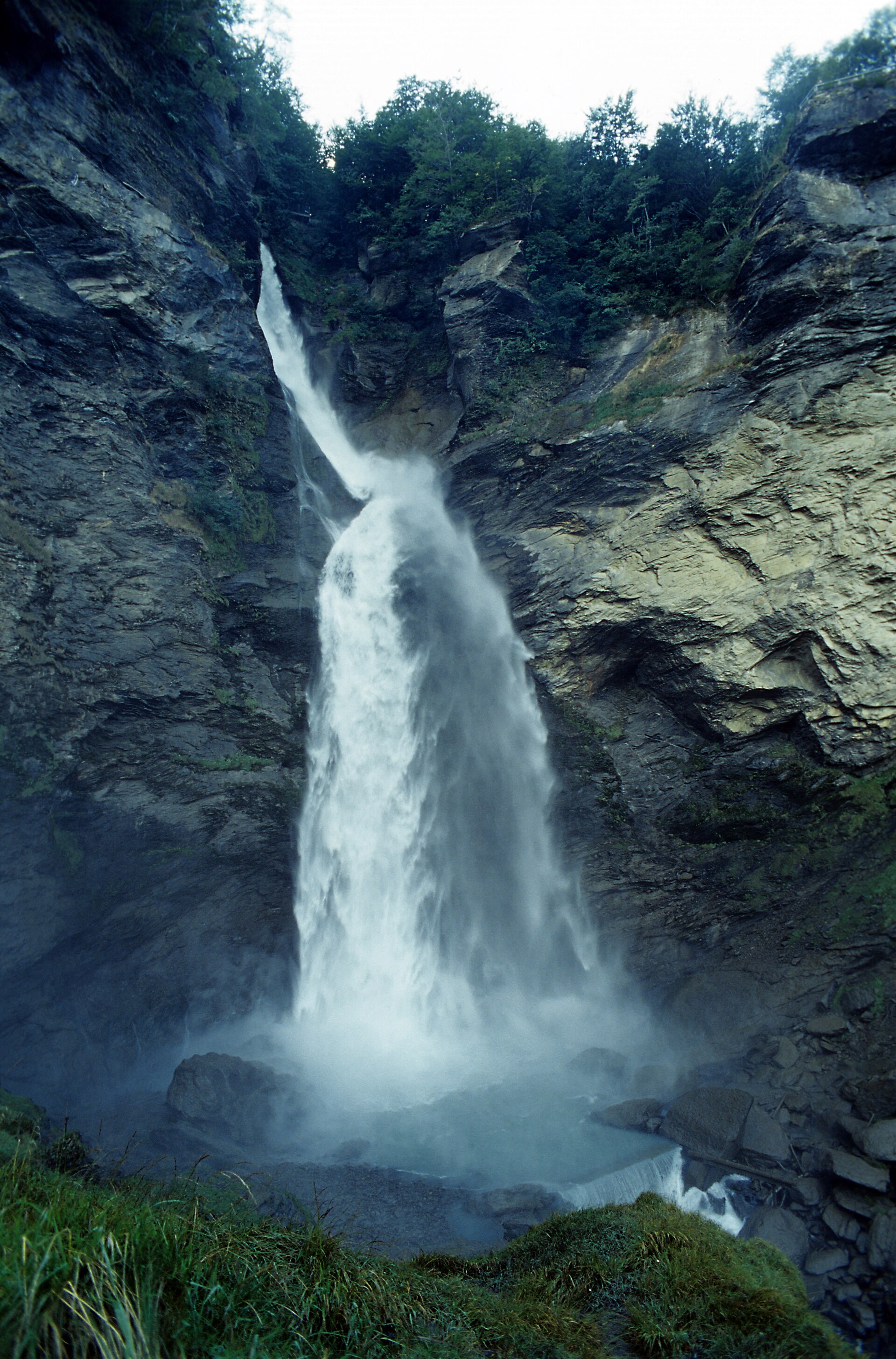
In December 1893, readers of The Strand Magazine opened "The Final Problem" and found Sherlock Holmes dead, tipped over a Swiss waterfall by Professor Moriarty, the two men locked together on a ledge above a drop Conan Doyle had seen with his own eyes only months earlier. The waterfall was not a literary invention. Reichenbach Falls, above the village of Meiringen in the Bernese Oberland, is a real cascade with a real drop of roughly 250 metres in its full series of tiers, and Conan Doyle walked its gorge path in August 1893 before writing the story that he hoped would let him stop writing Holmes altogether. This is the case file: what the text says, what the falls actually look like, and what remains to be checked on site.
The visit that produced the scene
Conan Doyle travelled through Switzerland with his wife Louise in the summer of 1893, part of a longer continental trip. He stayed in Meiringen, a small town in the Hasli valley reached today by train via Interlaken (roughly 45 minutes from Interlaken Ost). From the village he would have taken the gorge path up toward the falls, a walk that still takes most visitors 20 to 30 minutes on foot, or a few minutes by the funicular that now runs from near the village to a viewing platform partway up. Biographers have generally agreed that the sheer, enclosed violence of the water, a solid volume blasting between rock walls rather than spilling in a broad sheet, is what fixed the location in his mind as the right place to end his detective.
What the text actually describes
In the story, Watson is lured away by a false message while Holmes waits near "a fearful place," the path described as cut into the cliff face above the falls, ending in a sheer rock wall with no way forward except back the way they came. Conan Doyle has Watson find two sets of footprints leading to the ledge and none leading away, plus Holmes's alpine-stock and a farewell note wedged under a stone. The physical detail that convinces most readers, the narrow ledge with nowhere to retreat but the path itself, matches the upper viewing area of the real gorge closely enough that few visitors who have walked it doubt which spot inspired the scene, even though the exact platform has been reinforced and fenced since the 1890s for safety.
The site today: what you can verify yourself
The modern viewing platform sits above the main fall, reached by the funicular (check the day's schedule, as it typically runs from late spring to mid-autumn only) or by a steeper footpath that stays open longer into the season, weather permitting. A bronze plaque near the upper platform marks the association with the story, and a modest memorial, not a grave, since Holmes's fictional body was never meant to be recoverable, gives context in English and German. The water itself is glacier-fed, loudest and fullest from June to early July when snowmelt from the Rosenlaui glacier area peaks, and noticeably thinner by late September. Spray reaches the lower path year-round, so waterproof footwear is worth it in any season.
Funicular tickets typically run CHF 10 to 12 one way for adults as of recent seasons; confirm current pricing locally. The walk from Meiringen station to the funicular base is about 15 minutes on a signed path. Bring a light jacket even in summer: the gorge traps cold air and constant spray.
Why Conan Doyle wanted Holmes gone
By 1893 Conan Doyle had written dozens of Holmes stories and felt, in his own later account, that the detective was crowding out the historical fiction he preferred to write. He told his mother he meant to kill Holmes "or I shall go out of my mind." The choice of Switzerland and specifically Reichenbach gave him a location dramatic enough to justify the finality: a fall from such a ledge, into water moving with that much force, reads as unsurvivable in a way a London rooftop never could. Public reaction was fierce. Readers reportedly wore black armbands, and The Strand lost subscribers. Conan Doyle held out for eight years before "The Hound of the Baskervilles" (set before the Reichenbach events) and ten years before resurrecting Holmes outright in "The Adventure of the Empty House" (1903), which retroactively explained the survival with a climbing technique and a conveniently departing Moriarty henchman.
Reading the story on site: a short itinerary
Most visitors who want to connect text to terrain spend half a day on this. Start at Meiringen's small Sherlock Holmes museum (modest entry fee, typically under CHF 10), which holds period editions of The Strand and maps the route Conan Doyle likely walked. Then take the gorge path or funicular up to the falls, read the relevant passage of "The Final Problem" at the upper platform (it is short, perhaps ten minutes aloud), and walk back down via the lower path for a different angle on the main drop. Elementary as a pilgrimage goes: no technical difficulty, sturdy shoes recommended, total walking time under two hours round trip excluding museum time.
What remains uncertain
No letter or diary entry definitively states "this exact ledge is the one." The link between site and story rests on Conan Doyle's known 1893 visit, the topographical match, and over a century of local and literary consensus, not a signed confession. Treat the plaque as commemorative rather than as courtroom evidence, and read the story once more at the platform: the case for this being Holmes's fall still holds up on the water alone.