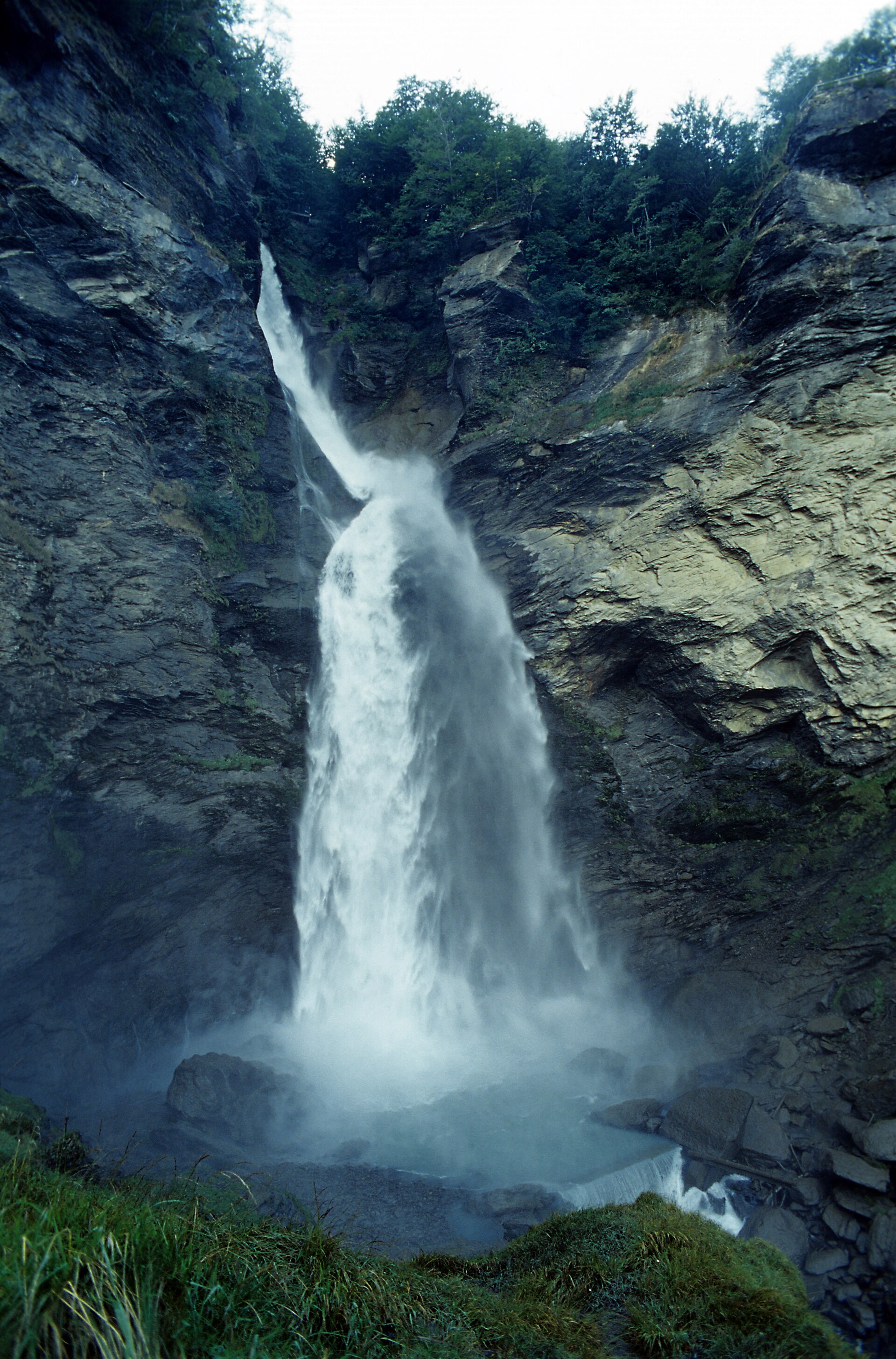
Every investigation needs a reliable route to the scene, and this one is unusually tidy. From Interlaken, Reichenbach Falls sits roughly 30 kilometres east, on the edge of Meiringen, and the journey can be done by train, by car, or (for the determined) partly on foot. None of it requires more than a morning, which leaves the afternoon free for the ledge itself and whatever else the valley has arranged.
By train: the backbone of the journey
The most dependable method is rail. From Interlaken Ost station, regional trains run to Meiringen roughly twice an hour, with the trip taking about 20 to 25 minutes. Fares are modest, typically in the range of 10 to 15 CHF one-way depending on the ticket type, and Swiss Travel Pass holders travel free on this stretch. The line itself is pleasant rather than dramatic, tracing the Aare valley past farmland and the occasional church spire before the mountains close in near Meiringen. Check the day's schedule before travelling, since frequency can thin out slightly in shoulder seasons.
From Meiringen station, it is a 15 to 20 minute walk to the base of the Reichenbach Falls funicular, or a short local bus ride if you prefer not to carry luggage across town. The funicular itself, a fixture since 1899, is covered in detail in a dedicated guide to its times and prices, which is worth reading before you set out, since its operating season is shorter than the trains that feed it.
By car: slower in town, faster on the open road
Driving from Interlaken takes about 30 to 35 minutes along the main valley road, assuming no summer traffic bottleneck at Brienz, which is common on fine weekends between June and August. Parking near the funicular's lower station is limited and fills early in high season; arriving before 10am on a sunny day is a reasonable precaution. If the small lot is full, overflow parking exists closer to Meiringen's centre, adding a ten-minute walk. There is no toll on this route, and the road is well maintained year-round, though winter closures of the funicular itself (see the seasonal note below) make a car trip in December or January mostly about the view, not the ledge.
By bus: the patient alternative
A postbus service connects Interlaken and Meiringen for travellers without a rail pass or those staying slightly off the train line, such as in parts of Grindelwald. Journey time runs close to 40 minutes, comparable to the train but with more stops. Tickets can be bought on board or in advance, at a price broadly similar to the rail fare. This option suits those who have already settled on accommodation choices outside Interlaken proper; our guide to where to stay for Reichenbach Falls compares Meiringen, Interlaken and Grindelwald as bases, each with slightly different transport logic.
Trains to Meiringen run year-round, but the funicular to the falls operates seasonally, typically from spring to autumn. Confirm current dates before building a day around the ledge.
On foot: for those who want the full approach
Walking the entire 30 kilometres from Interlaken is not realistic as a single day's outing, but a partial walk is a genuine option for hikers staying in Meiringen. From the town, a marked trail climbs to the falls in about 45 minutes to an hour, gaining roughly 200 metres in elevation, an alternative to the funicular for those who prefer their ascent on foot and their descent by machine, or the reverse. The path is well signed and not technically demanding, though sturdy shoes are sensible given the spray near the top.
Timing the whole trip
A realistic plan: leave Interlaken by late morning, reach Meiringen within 25 to 40 minutes depending on mode, ride or walk up to the ledge, and allow a further 45 minutes to an hour there before descending. Including transfers, the round trip from Interlaken comfortably fits into half a day, which is precisely the scope covered in the half-day guide to visiting the falls. Those wanting to extend the outing often combine it with Meiringen's small museum dedicated to the detective, detailed in a separate piece on the 221B in a crypt.
Seasonal considerations worth weighing
Water volume, and therefore the drama of the scene, varies considerably through the year, a subject covered more fully elsewhere on this site. Early summer, when snowmelt swells the Reichenbach, tends to produce the loudest and most forceful falls, while late autumn offers a quieter, clearer view. Whichever month you choose, the transport logic above holds steady: the train to Meiringen runs reliably, and only the final ascent changes character with the seasons. Elementary enough, Watson, once the timetable is in hand.