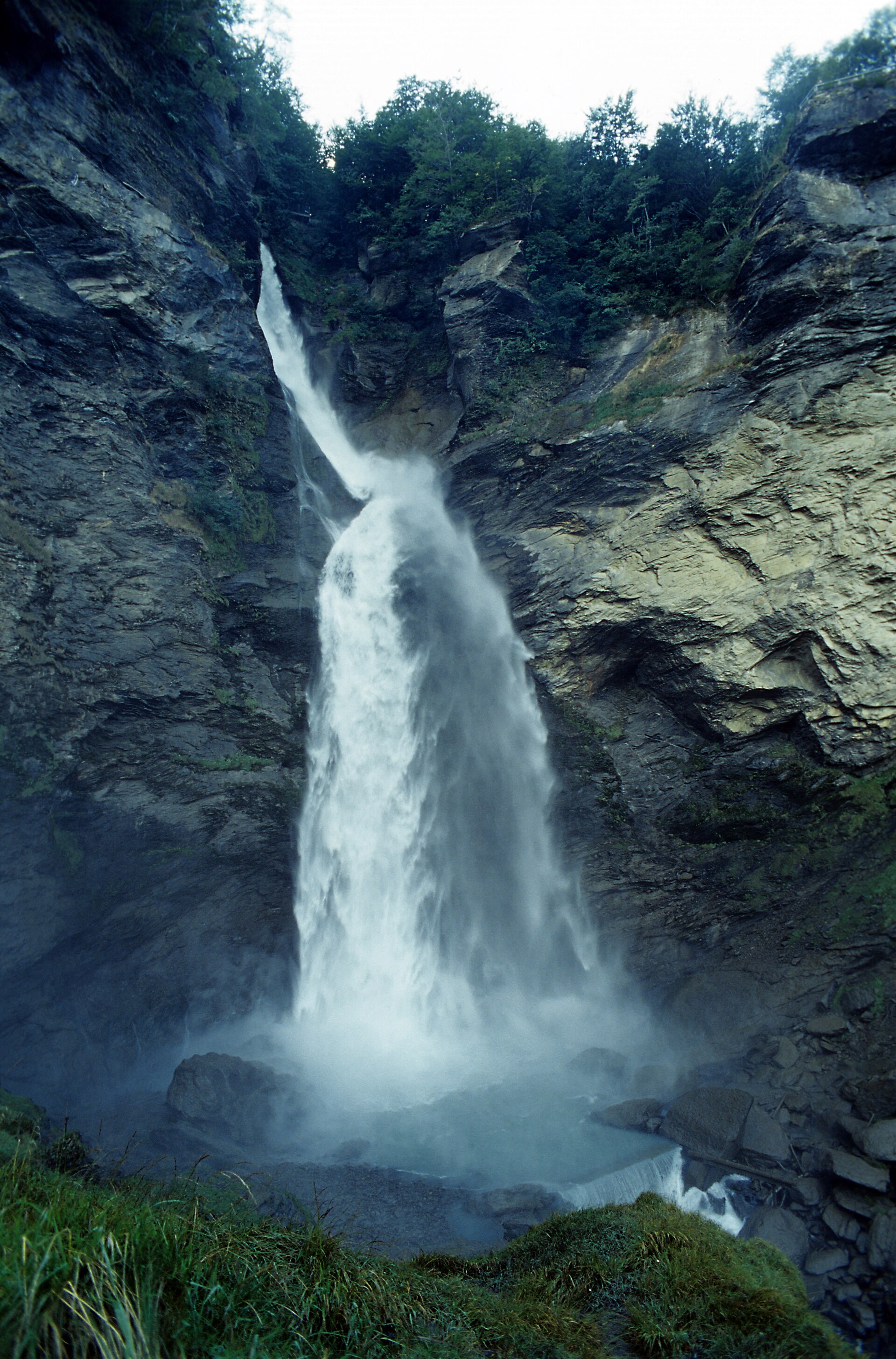
The question arrives with predictable regularity: Reichenbach or Trümmelbach, and if time allows only one, which deserves it. Both sit within the Bernese Oberland, both are fed by glacier water, and both have built an entire visitor industry around a single plunging column. But they are different cases entirely, one a vertical drop you watch from outside, the other a system of ten falls you enter through the rock itself. The verdict depends less on which waterfall is "better" than on what kind of encounter you are after.
The setting: open ledge versus hollowed mountain
Reichenbach Falls drops around 120 metres above Meiringen in a series of steps, with the upper fall visible from a viewing platform reached by funicular or on foot. The experience is open-air: pine forest, a wooden ledge, spray on a warm day, and the famous literary backdrop of Holmes and Moriarty's final struggle. Trümmelbach, near Lauterbrunnen, is a different animal altogether. Ten glacier-fed falls run inside the mountain, carved through limestone over millennia, and visitors walk through tunnels and lit galleries to see them. It is the only glacier waterfall system in Europe accessible by funicular from inside the rock, which gives it a damp, cathedral-like intensity that Reichenbach, for all its drama, does not attempt to replicate.
Getting there: time and transfers
Reichenbach Falls sits a short walk from Meiringen's train station, with the base station of the funicular roughly ten minutes on foot from the centre. If you are coming from Interlaken, the rail journey takes about 25 to 30 minutes with a change, detailed step by step in this Interlaken to Reichenbach journey guide. Trümmelbach requires a bus from Lauterbrunnen station, roughly 15 minutes, or a longer walk along the valley floor past Stechelberg. Neither site is difficult to reach, but Reichenbach has the edge for anyone basing themselves in Meiringen itself, while Trümmelbach suits travellers already settled in the Lauterbrunnen valley for its own waterfalls and cliffs.
Cost and timing on the day
Expect to pay in the region of CHF 10 to 14 for the Reichenbach funicular return, with the full half-day visit, including the walk to the upper ledge, taking around two to three hours. Full current fares and the operating calendar are kept up to date in the dedicated funicular times and prices page. Trümmelbach's entry fee, including its own internal funicular, tends to run a little higher, closer to CHF 14 to 16, reflecting the lit tunnels and maintained walkways. A full circuit of all ten falls at Trümmelbach takes about an hour to ninety minutes, somewhat shorter than a leisurely Reichenbach visit, since there is no forest trail component once you are inside.
Reichenbach's funicular typically runs from spring to autumn; Trümmelbach operates on a similar window, closing through the coldest months when ice makes the internal walkways unsafe. Check the day's schedule for both before building an itinerary around them, since neither runs year-round.
What you actually see and hear
Reichenbach rewards patience: the sound builds as you climb, and the upper platform gives a near-vertical view down the gorge with Meiringen laid out below. It is a single, legible scene, elevated by the Conan Doyle connection explored in depth in this annotated account of The Final Problem. Trümmelbach offers volume instead of a single view: ten separate falls, each with its own character, some roaring through narrow chutes, others spreading into wider cascades, all lit for visibility inside the tunnels. Neither approach is more "authentic" than the other, but if you want one clean, photographable moment, Reichenbach wins; if you want immersion in moving water from multiple angles, Trümmelbach has the range.
Crowds, weather and the free alternative
Trümmelbach's indoor galleries make it a reliable wet-weather choice, since rain does not touch the experience once you are inside the mountain. Reichenbach is entirely exposed, better suited to clear afternoons when the ledge view is unobstructed and the forest walk pleasant underfoot. Both sites draw coach groups in July and August, with mid-morning the busiest window at each. If budget or time rules out the funicular altogether at Reichenbach, there are several places to glimpse the falls without paying, covered in this guide to free views on foot, though no equivalent free vantage exists at Trümmelbach given its enclosed structure.
The verdict, such as it is
Elementary, perhaps, but worth stating plainly: choose Reichenbach if the literary pilgrimage matters to you, if you want a single dramatic viewpoint, and if you are already in the Meiringen valley for the Aare Gorge or Rosenlaui. Choose Trümmelbach if volume and variety of water interest you more than narrative, if you are staying in Lauterbrunnen regardless, or if the forecast is poor. Ambitious travellers with a full day and a car or good rail connections can manage both, since the two sites sit roughly 40 minutes apart by road. Where you lay your head afterward is its own decision, and the options across both valleys are compared in this guide to where to stay near Reichenbach Falls. Either way, pack a waterproof layer: both falls will find a way to make you damp before you leave.